Because conventional light oil can typically be produced at a high rate and a low cost, it has been used before other types of oil. Thus, conventional oil accounts for a declining share of the Earth's remaining oil endowment. In addition to assessing conventional oil resources, scientists of the U.S. Geological Survey's Energy Resources Program collect data on the abundant energy resources available as heavy oil (including extra-heavy oil) and natural bitumen; see definitions in sidebar. The data in this Fact Sheet are compiled from commercial databases (NRG Associates, I.H.S. Petroconsultants), unpublished government data, and the published literature.
Natural bitumen (often called tar sands or oil sands) and heavy oil differ from light oils by their high viscosity (resistance to flow) at reservoir temperatures, high density (low API gravity), and significant contents of nitrogen, oxygen, and sulfur compounds and heavy-metal contaminants. They resemble the residuum from the refining of light oil. Most heavy oil is found at the margins of geologic basins and is thought to be the
evaporation.
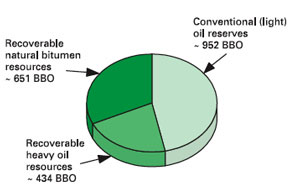
The estimated volume of technically recoverable heavy oil (434 billion barrels) and natural bitumen (651 billion barrels) in known accumulations is about equal to the Earth's remaining conventional (light) oil reserves (table 1, fig. 1).
Table 1. Regional distribution of estimated technically recoverable
heavy oil and natural bitumen in billions of barrels (BBO).
|
| Region |
Heavy oil
|
Natural bitumen
|
Recovery
factor* |
Technically
recoverable BBO |
Recovery
factor* |
Technically
recoverable BBO |
|
| North America |
0.19 |
35.3 |
0.32 |
530.9 |
| South America |
0.13 |
265.7 |
0.09 |
0.1 |
| W. Hemisphere |
0.13 |
301.0 |
0.32 |
531.0 |
| Africa |
0.18 |
7.2 |
0.10 |
43.0 |
| Europe |
0.15 |
4.9 |
0.14 |
0.2 |
| Middle East |
0.12 |
78.2 |
0.10 |
0.0 |
| Asia |
0.14 |
29.6 |
0.16 |
42.8 |
| Russia |
0.13 |
13.4 |
0.13 |
33.7** |
| E. Hemisphere |
0.13 |
133.3 |
0.13 |
119.7 |
| World |
|
434.3 |
|
650.7 |
www.bitumen.loxblog.com |
*Recovery factors were based on published estimates of technically
recoverable and in-place oil or bitumen by accumulation. Where
unavailable, recovery factors of 10 percent and 5 percent of heavy oil
or bitumen in place were assumed for sandstone and carbonate
accumulations, respectively.
**In addition, 212.4 billion barrels of natural bitumen in place is located in
Russia but is either in small deposits or in remote areas in eastern Siberia.
 |
|
Figure 1. Distribution of the world's known recoverable oil resources and reserves by type. Technically recoverable oil in known heavy oil and natural bitumen accumulations is about equal to reserves of light oil (API gravity greater than 22°) in known conventional accumulations. BBO, billion barrels of oil. |
In spite of an immense resource base, heavy oil and natural bitumen accounted for only about 3 billion barrels of the 25 billion barrels of crude oil produced in 2000. Compared to light oil, these resources are generally more costly to produce and transport. Also, extra-heavy oil and natural bitumen must usually be upgraded by reducing their carbon content or adding hydrogen before they can be used as feedstock for a conventional refinery. The extra production, transportation, and upgrading costs explain why development and production of extra-heavy oil and bitumen are still limited. Their abundance, strategic geographic distribution, quality, and costs will shape their role in the future oil supply.


 عضو شوید
 عضویت سریع


 آمار مطالب
 آمار بازدید


